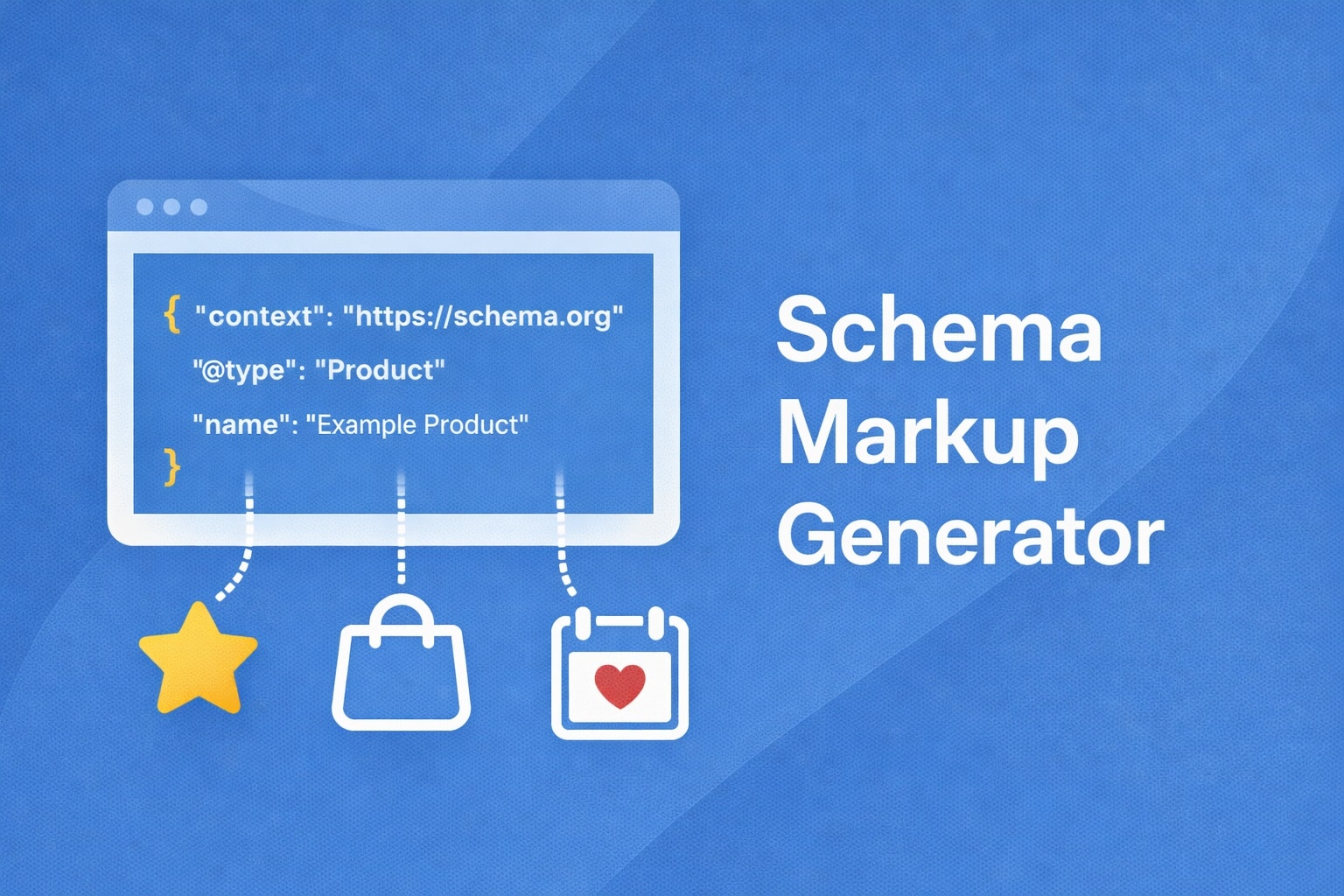
Schema Markup Generator: Create Structured Data Easily
Structured data helps search engines understand your page content better – and rewards you with rich results: star ratings, FAQ accordions, recipe images, and more directly in search results. The problem: JSON-LD syntax is error-prone, and a single missing comma invalidates the entire markup.
This tool generates valid JSON-LD schema markup for 10 different types. Fill in the form, and you will get ready-to-use code to copy or download. For articles, products, and organizations, the tool can auto-fill fields from a URL.
Schema Markup Generator
Generate valid JSON-LD schema markup for your website.
How the Schema Markup Generator Works
- Choose a schema type: Select one of the 10 available types: Article, Local Business, Product, Organization, FAQ, HowTo, Recipe, Event, Review, or BreadcrumbList.
- Fill in the form: Required fields are marked. Fill in as many optional fields as possible – the more complete the markup, the higher the chance of rich results.
- Use auto-fill (optional): For Article, Product, and Organization, you can enter a URL. The tool automatically extracts title, description, image, author, and other data from the page’s meta tags, Open Graph data, and existing JSON-LD.
- Copy or download the markup: Click “Copy” for the clipboard or download the JSON file.
- Add it to your website: Insert the generated code into the
<head>section or at the end of the<body>section of your page.
Available Schema Types
- Article: Blog posts and news articles with author, date, and image
- Local Business: Local businesses with address, opening hours, and contact details
- Product: Products with price, availability, and rating
- Organization: Company information with logo, address, and social media links
- FAQ: Question-answer pairs that appear as FAQ rich results in search
- HowTo: Step-by-step instructions with optional images and time estimates
- Recipe: Recipes with ingredients, preparation time, and nutritional information
- Event: Events with date, venue, and ticket information
- Review: Reviews with author, rating scale, and reviewed entity
- BreadcrumbList: Breadcrumb navigation as structured data
Changelog
- Added BreadcrumbList as the tenth schema type with automatic position numbering
- Implemented auto-fill from URL for Article, Product, and Organization – extracts data from JSON-LD, Open Graph, Twitter Cards, and meta tags
- Dynamic adding and removing of entries for FAQ, HowTo steps, and breadcrumb items
- JSON file download as an alternative to clipboard
- Visual highlight on auto-filled fields
Background: Why Structured Data Improves Your Visibility
Structured data (schema markup) is a standardized format for providing search engines with additional information about page content. Google, Bing, and other search engines use this data to display rich results in search.
What Do Rich Results Deliver?
- More space in search results: FAQ results, star ratings, and recipe images take up significantly more room than a standard snippet.
- Higher click-through rate: Studies show that rich results can increase CTR by 20–30%.
- Better user information: Price, availability, and ratings are displayed directly in search results before the user visits your site.
JSON-LD: The Recommended Format
Google recommends JSON-LD as the preferred format for structured data. Unlike Microdata or RDFa, JSON-LD is embedded as a standalone script block and does not modify your page’s HTML code. This makes it easier to implement and maintain.
What Should You Do With the Generated Markup?
- Embed it: Insert the JSON-LD code into your page – ideally in the
<head>or before the closing</body>tag. - Test it: Validate the markup with Google’s Rich Results Test to ensure it is correctly recognized.
- Monitor it: Check Google Search Console under “Enhancements” to see whether rich results are being generated for your pages.
Frequently Asked Questions
Frequently Asked Questions
What is structured data?
Structured data is a standardized format (based on schema.org) that provides search engines with additional information about your page content. JSON-LD is the format recommended by Google.
Does schema markup guarantee rich results?
No. Structured data makes your page eligible for rich results, but Google decides whether and when to display them. Correct implementation, relevant content, and a solid overall SEO foundation significantly increase the likelihood.
Can I use multiple schema types on one page?
Yes. A recipe page can contain Recipe, BreadcrumbList, and FAQ markup simultaneously, for example. Each type is embedded as a separate JSON-LD block.
What does the auto-fill feature do?
When you enter a URL, the tool fetches the page and automatically extracts relevant information from existing meta tags, Open Graph data, Twitter Cards, and embedded JSON-LD. Fields you have already filled in are not overwritten.
How current are the schema types?
The types and their required fields follow Google’s current recommendations for rich results. Since these recommendations can change, we recommend periodically validating generated markup with Google’s Rich Results Test.