Projects
Our own projects show how we work.
A web application for local businesses, a catalog for local AI, a learning app for children, four Chrome extensions, an AI tool for teachers, and the portal where it all began in 2016. Built by Sercan Kahraman and Minoka GbR.
Web application for local businesses
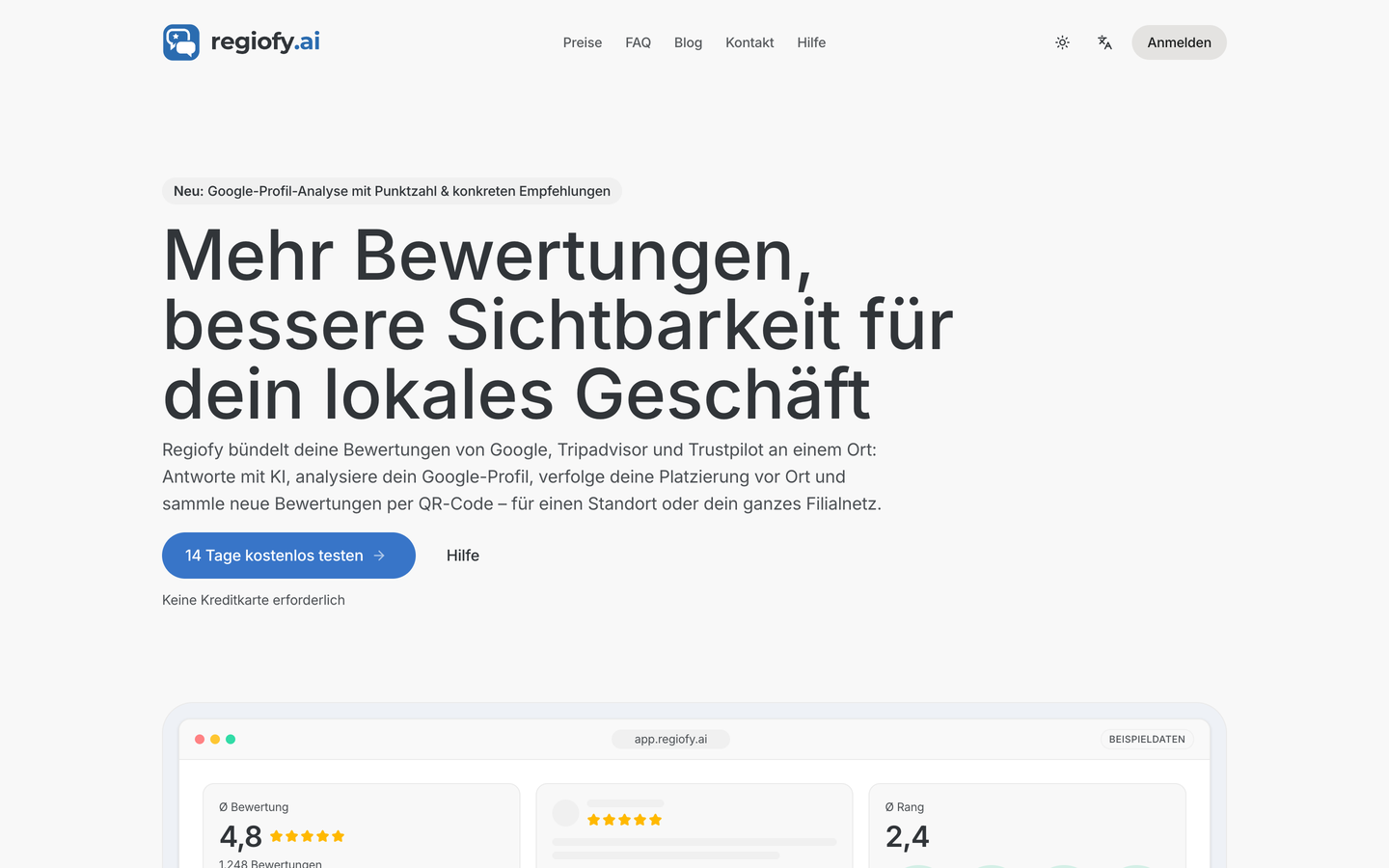
regiofy.ai brings reviews from Google, Tripadvisor, and Trustpilot together in one place.
Local businesses, chains, and agencies answer their reviews with AI suggestions and collect new reviews via QR code. Chains and agencies also see where their locations rank in local search.
How it started
QR codes and print templates for reviews used to be made by hand, and there was no shared overview for multiple locations. A first WordPress solution produced the print material; from 2025 it grew into its own web application.
In 2026 we moved it, with all 48 data models, onto a new technical foundation. The website now runs on the same stack.
Web application · since 2025
What we built
- Three platforms, one interface. On setup, regiofy.ai loads the existing reviews (up to a limit per platform, 4,490 on Google), then the new ones on a regular schedule.
- Google profile analysis. A score with concrete recommendations for what to improve on the profile.
- Print material in your own colors. Print-ready templates with QR code; the tool suggests the colors from the company logo.
Catalog for local AI
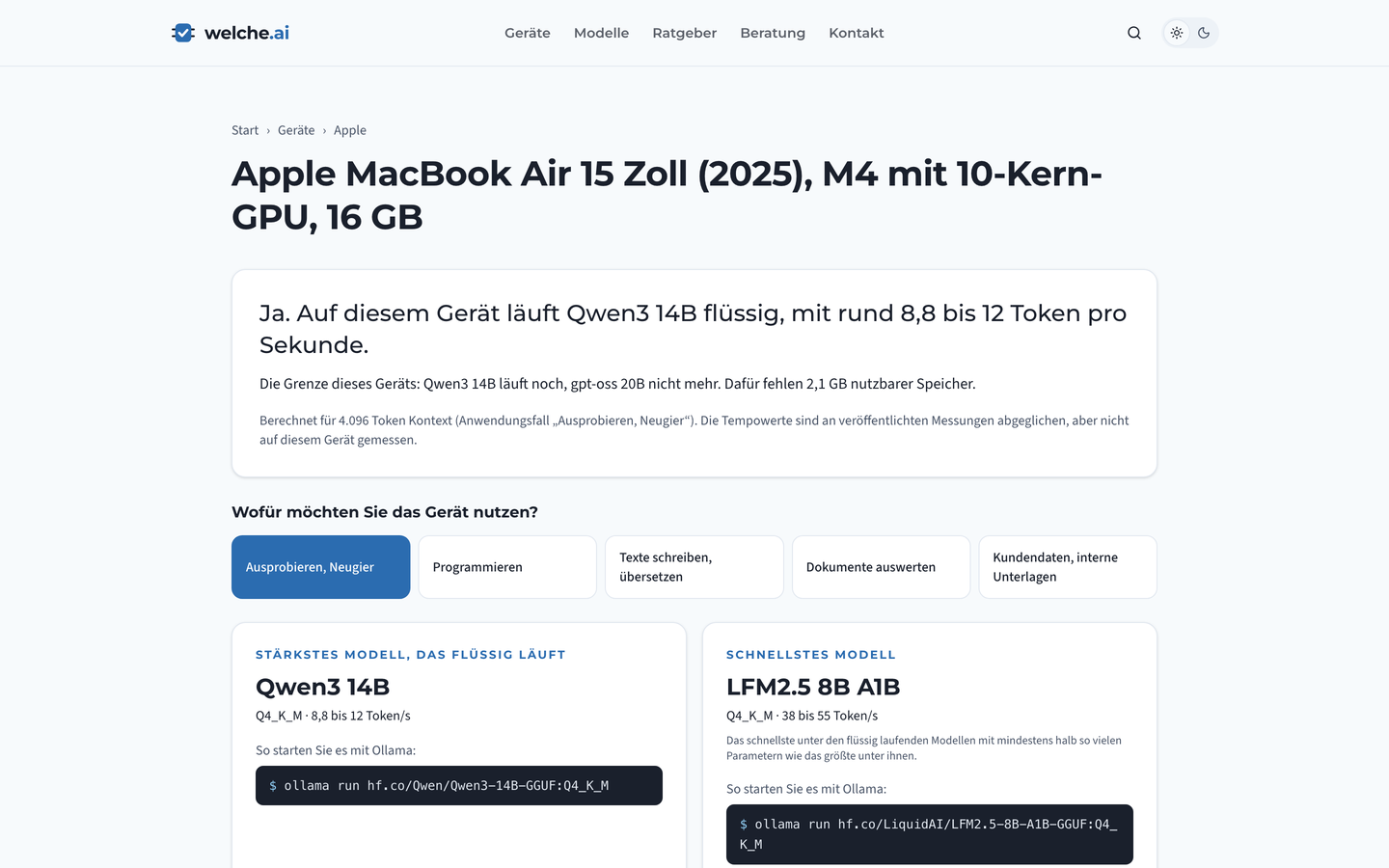
welche.ai answers which local AI runs on your device.
In German and for more than 500 devices: which models run on them, how fast, and with which command you start them.
How it started
Hardly anyone knows the size of their graphics memory, but almost everyone knows their device. The online calculators we found asked for the graphics card and chip instead of the device.
Two days passed between the concept and the public site. Since then the work is split: welche.ai answers the question about the device, Minoka provides the consulting.
Catalog and guides · public since 2026
What we built
- One formula for speed. How fast a model writes its answer on a device, welche.ai calculates from the device’s memory bandwidth and the model’s size. The formula is calibrated against more than 200 measurements, from published test series and our own tests.
- A catalog built from primary sources. Model data straight from Hugging Face and from the model file itself, device data with a source per device series.
- The answer first. Every device page opens with one sentence, names the device’s limit, and recalculates per use case.
- The privacy traffic light. “What leaves your building?” compares four ways to run a model. Each rating comes with a verbatim quote from the respective provider’s own documentation.
Learning app for children
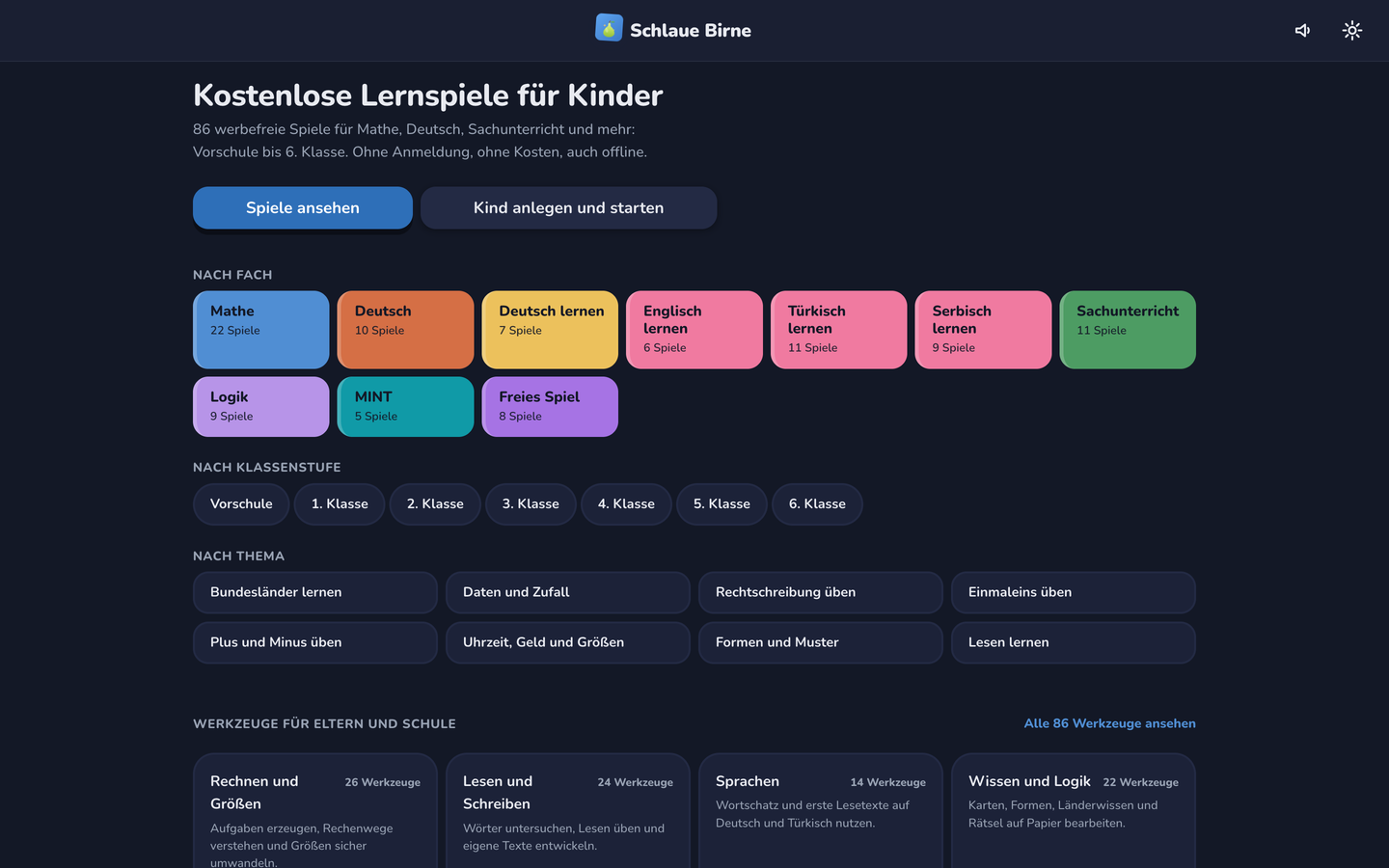
Schlaue Birne is a free learning app for children, with no ads and no account.
96 learning games from preschool to 6th grade, plus 86 tools for parents and schools, from worksheets to a learning clock.
How it started
It started with a question that is still on the site: “Why do learning apps look so boring?” The first version from 2025 was a number game, today called “Mathe-Stadt” (Math City): children solve decomposition tasks and build a city while doing so.
Its pattern of series, collections, and no penalty for mistakes now applies to all games. From 2026 it grew into today’s app.
Learning app in the browser · first version 2025
What we built
- Privacy as a design principle. Progress stays on the device, a backup is voluntary and encrypted, the font is served from our own server.
- Play before you can read. More than 17,000 pre-generated voice prompts in four languages guide children through the games.
- Works without internet. An installable web app: after the first load, the games also run offline.
- Learning German with support. For children with a different first language, with hints in Turkish, Arabic, and Ukrainian.
- A curriculum with a test. A curriculum entry only counts as covered once there is a game or tool and an automated test for it.
Browser extension for SEO
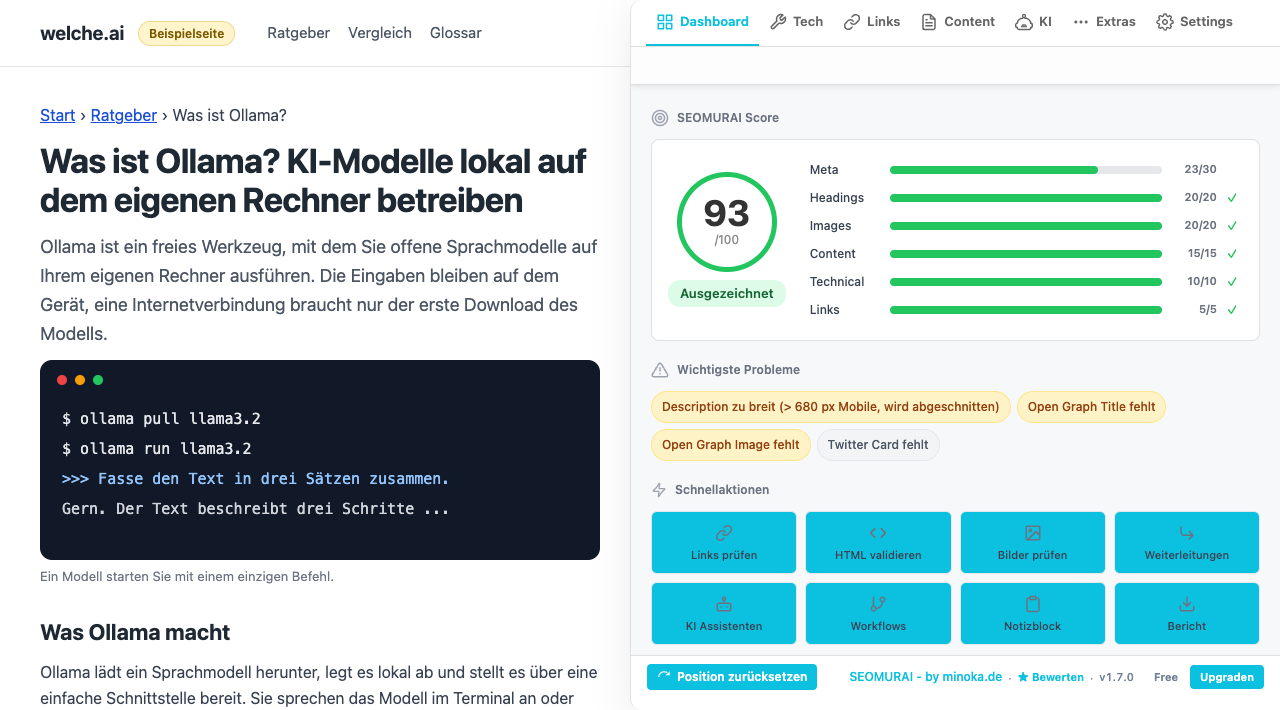
SEOMURAI checks the open page for technology, content, links, and structured data.
One Chrome extension, with no crawl and no account. Optionally with DataForSEO data and AI models, each through your own credentials.
How it started
It started with the daily gap in SEO work: one tool for meta tags, a second for schema, a third for readability, a fourth for backlinks, and none of them showed the one page that was open right now, in real time. SEOMURAI closes exactly that gap.
Today it includes a connection to local AI models, a checker for 156 AI crawlers, and an interface in 15 languages. The page analyses run in the browser; nothing is sent to us.
Chrome extension · free, with a Pro tier
What we built
- Seven tool areas. From technical SEO through content and links to the AI connection, with a score and the page’s most important issues at a glance.
- Your own keys, your own data. DataForSEO and AI providers connect with your own credentials. We never see the data and add no markup.
- AI, locally too. Models on your own machine (Ollama, LM Studio, llama.cpp) or with Chrome AI right in the browser, with no API key there.
- 15 languages. Including Arabic and Hebrew with right-to-left layout.
Browser extension for buying property
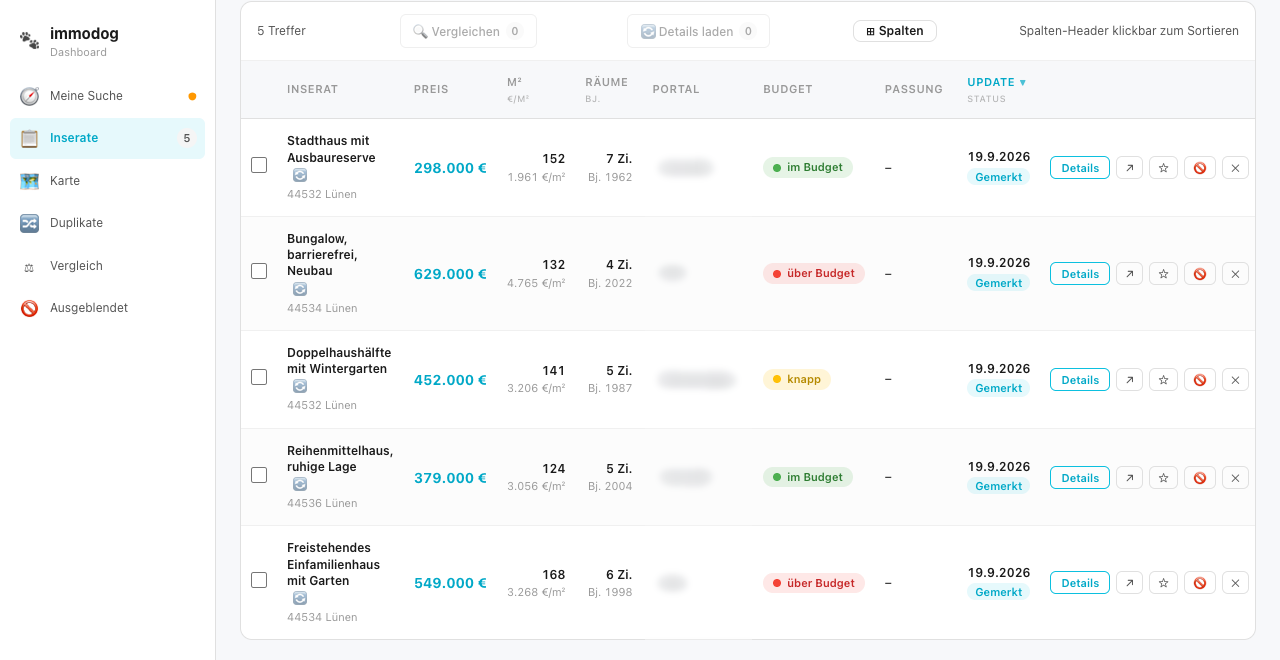
immodog collects saved listings from four property portals in one list.
The Chrome extension recognizes the same property across several providers and shows per listing whether it fits the budget. The watch list stays local in the browser.
How it started
It started with the typical problems of buying: no watch list across portals, duplicate listings, an unclear budget. In 2026 the foundation was set in one day: owner-occupiers as the audience, a local watch list, four portals.
immodog appeared in the Chrome Web Store the same year, followed by location analysis and a map.
Chrome extension · free
What we built
- Duplicate listings without image comparison. A two-stage fingerprint compares, among other things, postal code, living area, year of construction, and number of rooms, across all portals.
- Location from official and open data. Standard land value, the 2022 census, and the surroundings from OpenStreetMap, with consent per feature. For these three analyses, only a point rounded to about 100 m is transmitted.
- A budget traffic light for all of Germany. With the real estate transfer tax of all 16 states, the ancillary costs, and affordability.
- Early warning. If a portal changes its page structure, the extension reports it.
More browser extensions
Besides SEOMURAI and immodog, we have published two more Chrome extensions.
Both install for free from the Chrome Web Store; bulkU also offers a Pro tier. The interface comes in 12 to 15 languages. Then there are the tools we build on commission.
Deftery
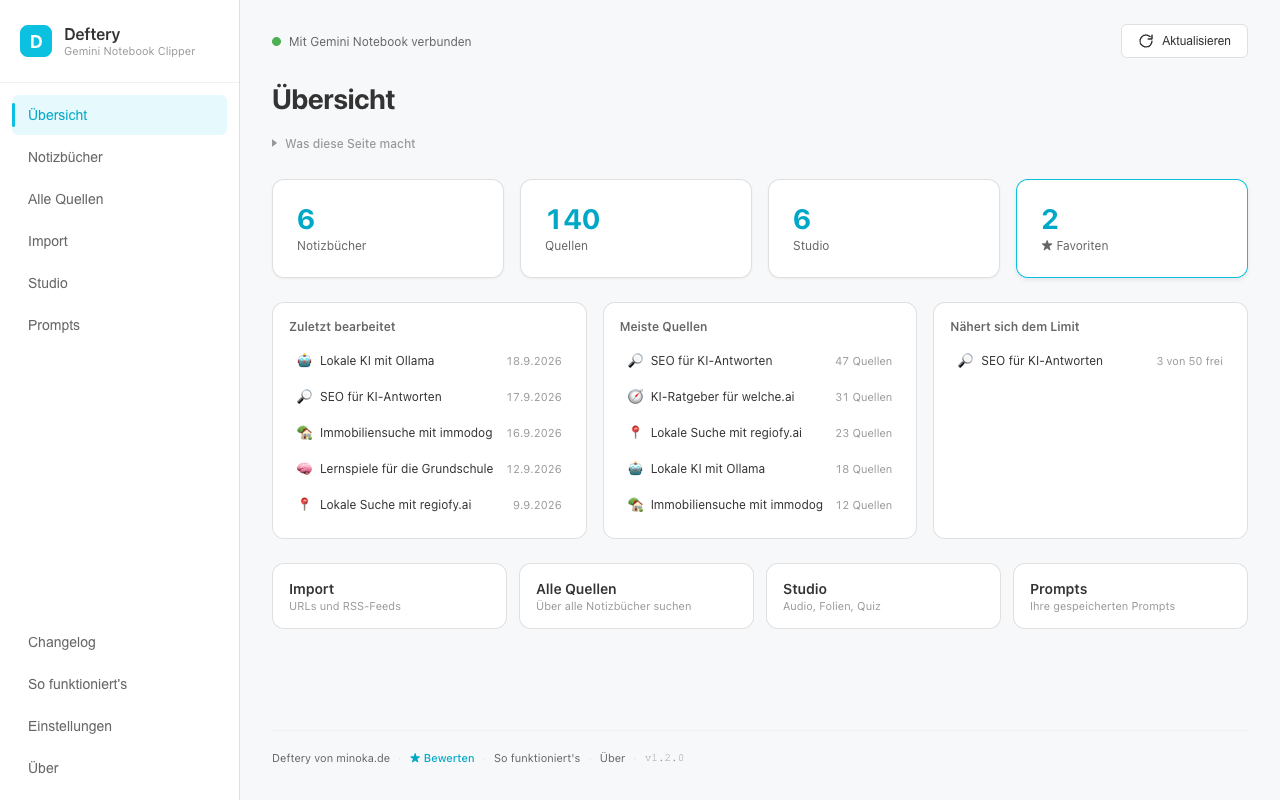
Sends web pages, text selections, RSS feed entries, and YouTube videos to your own notebooks in Gemini Notebook (formerly NotebookLM), without copying and pasting.
- Also imports the videos of a YouTube channel, up to 500 at once, and entire playlists.
- Completely free, interface in 15 languages.
bulkU
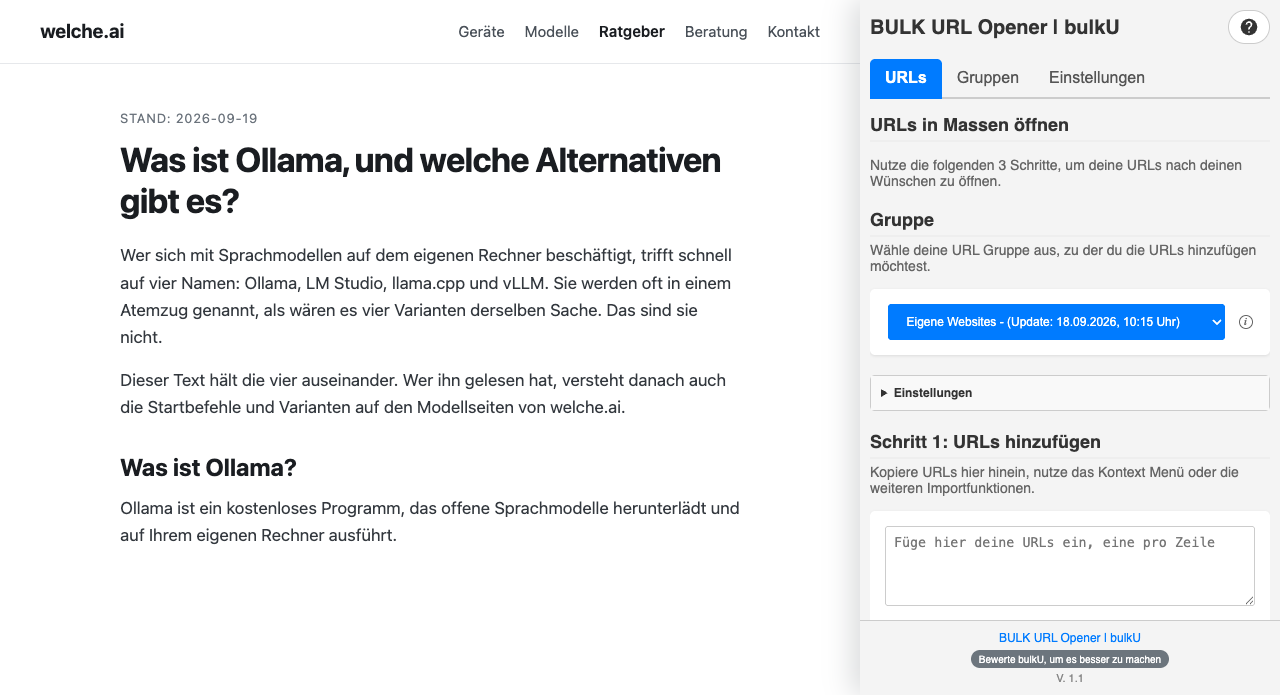
Opens long URL lists at once, in batches with adjustable pauses, and manages them as named groups.
- Opens WordPress posts directly in the editor on request.
- Interface in 12 languages, with light and dark themes.
Custom Tooling: tools on commission
Besides our own extensions, we build tools on commission, tailored to the workflows of the respective company. These projects are under non-disclosure agreements; that is why we name no clients and show no screenshots.
- We describe one example anyway: an extension that plans delivery routes right inside the client’s system.
Teaching and school
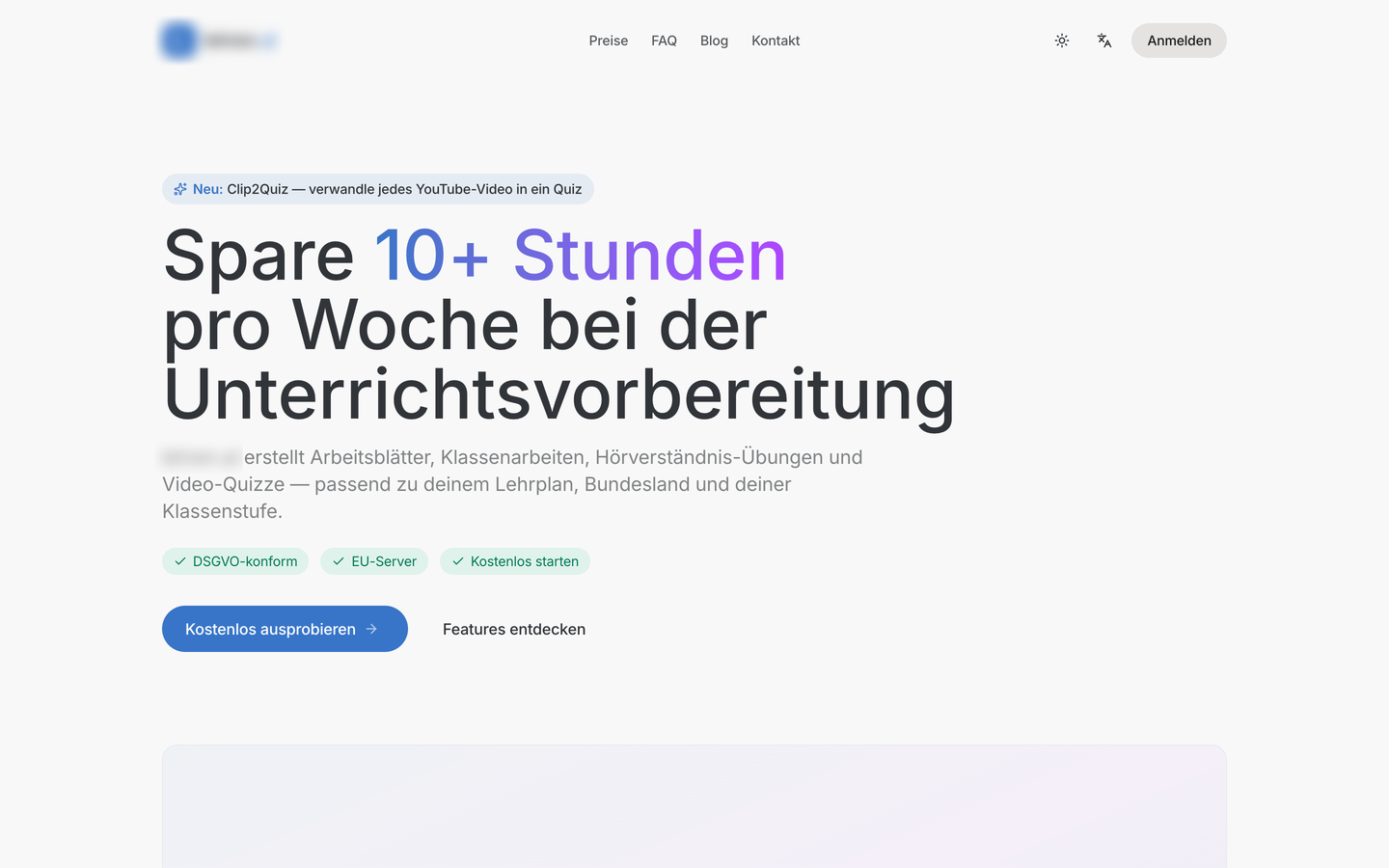
An AI tool for teachers at German schools.
It generates teaching material, class tests, video quizzes, listening exercises, and letters to parents, each matched to the federal state, school type, and grade level.
Conceptual design and a first test with teachers.
How it started
It started with a concept: relieve teachers of recurring tasks, from lesson planning through class tests to grading, with the requirement that everything follows the GDPR. After a first version it was rebuilt on a foundation that can manage several schools separately.
Then came concrete changes: grades 1 to 4 for primary school, special-needs schools as a school type, and freely selectable lesson lengths from 15 to 180 minutes.
Since 2026
What we built
- A foundation for the curricula of all 16 states. Built to read curriculum PDFs, extract topics and competencies with AI, and feed matching excerpts into generation.
- Letters to parents in 21 languages. Including Arabic, Farsi, and Hebrew with right-to-left layout, as HTML, Word, and PDF.
- Results with a verification layer. Structured into phases, tasks, points, and requirement levels. The verification layer flags contradictions, such as a wrong point total.
- School context without input. A school database is connected; school type and federal state follow automatically.
Where it all began
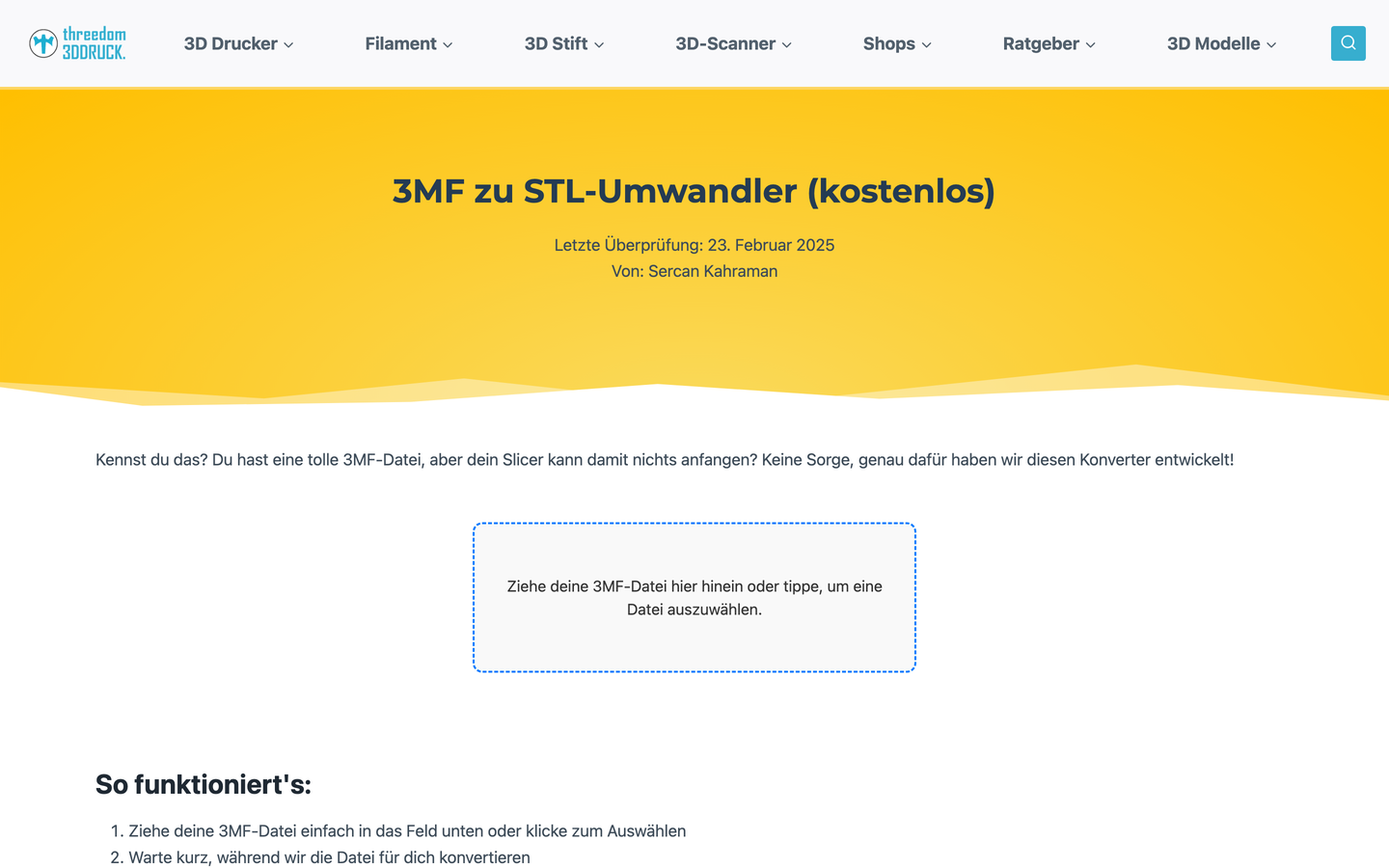
It all started with threedom.de in 2016.
A German-language 3D printing portal with guides, buying advice, template collections, and free tools for beginners and makers.
How it started
Sercan Kahraman has worked with 3D printing since 2013; the name combines “freedom” with “threed” for 3D. The first article appeared in 2016.
On threedom, Sercan Kahraman gained his first experience in search engine optimization: on-page optimization, link building, and content strategy were tested here in practice. In 2017 minoka.de started as an SEO consultancy; from 2018 SEO became his main profession.
3D printing portal · since 2016
What we built
- A topic portal built up since 2016. More than 250 pages, created between 2016 and 2025: guides, buying advice, and overviews of manufacturers, retailers, filament, and 3D pens.
- The 3MF-to-STL converter. Free, converts files on the server and deletes them after a few minutes.
- 43 template collections. Curated collections of 3D models to print.
The founders
The founders introduce themselves on their own sites.
Two personal sites, built lean and linked to minoka.de: in the data for search engines, both people carry the same identifier as on minoka.de.
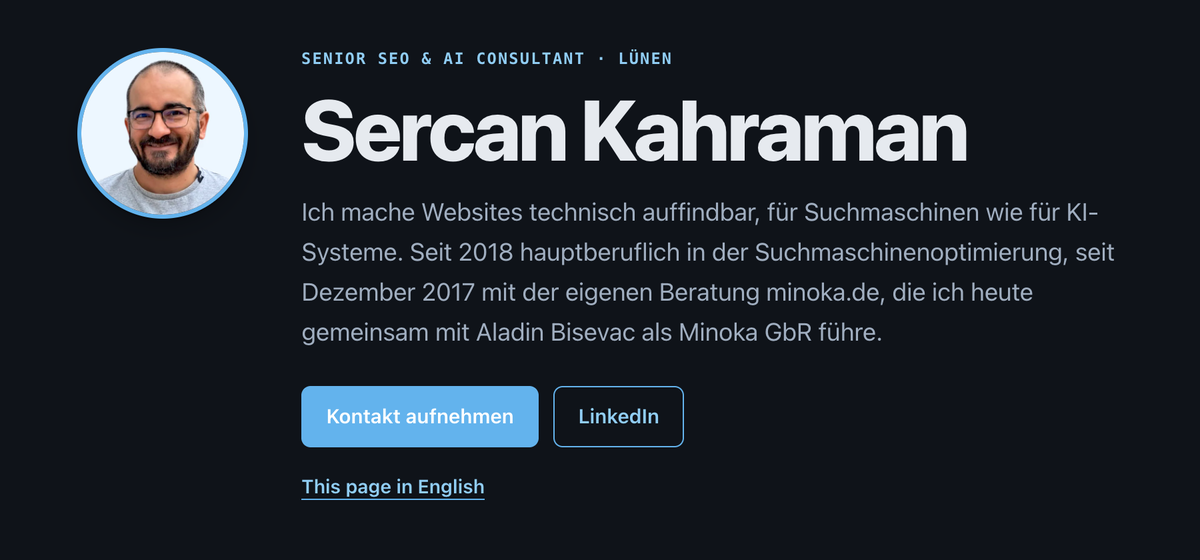
Sercan Kahraman
Profile, articles, and qualifications, plus topic pages on technical SEO and visibility in AI answers, and an overview of SEO conferences.
- No JavaScript, no cookies, no requests to third-party servers; the home page loads about 43 KB.
- In German and English, since 2026.
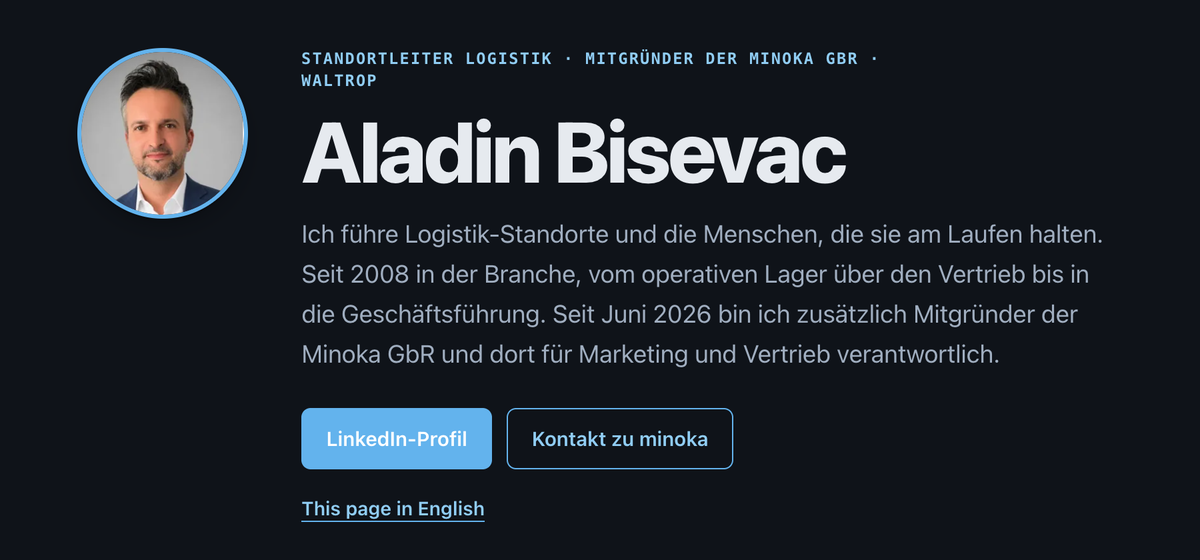
Aladin Bisevac
Short profile, career stations, qualifications, and frequently asked questions. Aladin Bisevac is co-founder of Minoka GbR and a site manager in logistics.
- The same lean build: no JavaScript, no requests to third-party servers.
- In German and English.
Consulting
We are happy to talk about your own project.
Figures: as of 2026.