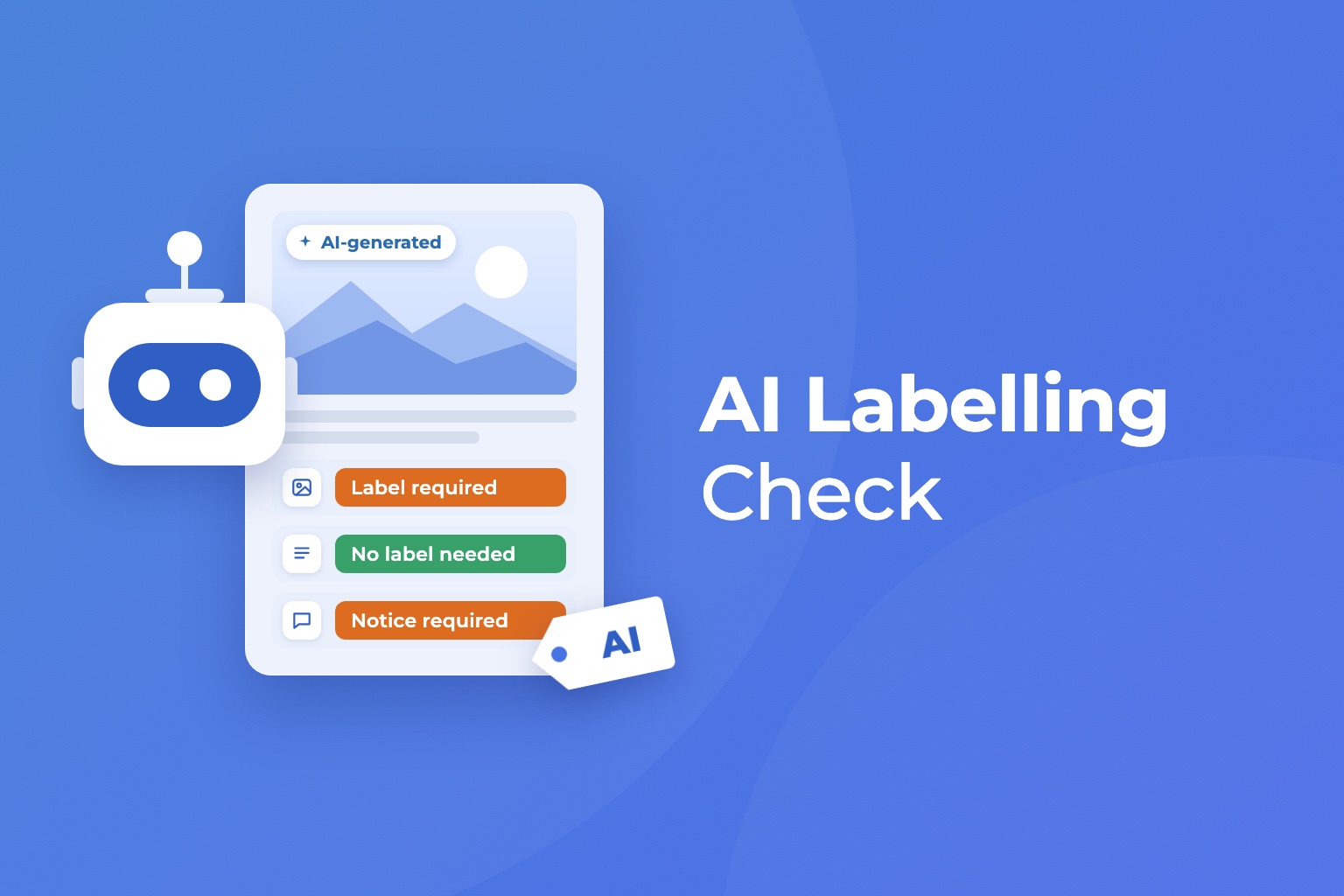
AI labelling check
Tool · EU AI Act
Answer three to six questions, up to ten if you provide an AI system yourself, and find out whether Article 50 of the EU AI Act requires you to label a piece of content. The result explains why and, where a visible notice is needed, gives you wording to copy.
Free, no sign-up.
Does this content need a label?
Before you start
Run the check once per item. The photo in a blog post and the text of that post can lead to different answers. You will be asked about your role (user of AI tools, provider of an AI system, or both), the type of content, what the AI did with it and, for images, video, audio and published texts, the date that counts.
Three situations, three answers
A price comparison site has AI write the descriptions of kitchen appliances. No label is required under Article 50. Product copy is not information on a matter of public interest, as long as it makes no claims about, for example, energy efficiency, safety or health.
A town council newsletter announces new waste collection days in a text drafted by AI and sent out without anyone checking it. Information about public services is a matter of public interest, and nobody reviewed the text, so the council has to disclose that it was generated by AI, at the start of the text.
An online shop shows an AI-generated video of a customer using its product, played by a person who does not exist. This is a deep fake. Under the Commission guidelines, a person who could plausibly exist meets that part of the definition, and viewers are meant to believe the customer is real. The disclosure should appear in the video itself, at the start and again later if viewers may join midway, and the metadata the tool added should stay in the file.
Who has to do what
The AI Act splits the transparency duties in Article 50 between the companies that build AI systems and the companies that use them. All of them have applied since 2 August 2026.
- Providers of systems that interact with people have to design them so that users know they are dealing with an AI, unless that is obvious (Article 50(1)).
- Providers of systems that generate text, images, audio or video have to mark the output in a machine-readable way, for example with watermarks or metadata (Article 50(2)). For systems placed on the market before 2 August 2026, the deadline is 2 December 2026 (Article 111(4)).
- Deployers of emotion recognition or biometric categorisation have to inform the people exposed to the system (Article 50(3)).
- Deployers who generate or manipulate deep fakes, or who publish AI-generated text that informs the public on matters of public interest without editorial review, have to disclose that the content is artificial (Article 50(4)).
A company that only uses AI tools is usually affected by the last point alone. Marking inside the tool is a job for the provider. The two duties do not replace each other: a missing watermark does not release you from disclosure, and a watermark the tool did add does not count as your disclosure either.
A deep fake, as defined in Article 3(60), is AI-generated or manipulated image, audio or video content that resembles existing persons, objects, places, entities or events and would falsely appear to a person to be authentic or truthful. A recognisable illustration, an abstract motif or a cartoon does not qualify, and neither does standard editing such as cropping, noise reduction or colour correction.
Where the notice goes
A line in the legal notice or the privacy policy is not enough. Article 50(5) requires the information to be given in a clear and distinguishable manner at the latest at the time of the first interaction or exposure, and to conform to the applicable accessibility requirements. In practice that means the caption of an image, the start of a text, the video itself, or the chat window before the first message.
For deep fakes that form part of an evidently artistic, creative, satirical or fictional work, disclosure still applies but may be made in a way that does not hamper the display or enjoyment of the work, such as in the credits.
To support disclosure under Article 50(4), the European Commission has published three icons: a basic icon, one for fully AI-generated and one for partially AI-modified content, each in black, white and both with 50 per cent transparency. Using them is optional; the labelling requirements of Article 50 are not. According to the Commission, user testing showed better results across all measures when the basic icon was accompanied by a text label.
Frequently Asked Questions
Frequently Asked Questions
Is the labelling obligation already in force?
Yes, since 2 August 2026. A transition period exists only for machine-readable marking under Article 50(2): providers whose system was placed on the market before that date have until 2 December 2026 (Article 111(4)). According to the Commission guidelines, images, video and audio generated or manipulated with AI before 2 August 2026, and texts published before that date, do not have to be labelled retroactively.
Does all AI-generated content need a label?
No. Texts need one only if they inform the public on matters of public interest and lack either a review of their substance by someone with the relevant expertise or a person or company holding editorial responsibility. Images, video and audio only need one if they could pass as real. Internal documents are not covered, and neither are advertising and product copy, unless they make claims about, for example, health, consumer safety or sustainability.
What counts as editorial review?
Someone with the relevant expertise has to review the substance of the text, at least checking the facts, and a person or company has to hold editorial responsibility for it. Who that is should be easy to find, for example in the legal notice, but naming them there does not replace the review. A spell check does not count as one either.
What about texts translated by AI?
The Commission guidelines point in two directions. In the section on Article 50(2), they count AI translation as standard editing; in the section on Article 50(4), they treat a reviewed translation as a case of the editorial exception. To be on the safe side, this check treats a translation as a change. If someone with the relevant expertise reviews the translation and someone holds editorial responsibility, Article 50 does not require a label.
Can I rely on the result instead of legal advice?
The result shows how Article 50 applies to the answers you gave and cites the provision behind it. It is not a legal opinion. Where emotion recognition, biometric data or real people are involved, get advice from a lawyer.
Limits of the check
Some questions stay outside this tool. It relies on what you tell it about the use of AI, because a description cannot reveal that. Personality rights, copyright and competition law apply in addition to Article 50 and are not assessed. Nor does the check decide whether a use is lawful at all: emotion recognition in the workplace and in education institutions, for instance, is prohibited by Article 5(1)(f) unless it serves medical or safety purposes.
Legal status
Legal status: 15 September 2026. These notes are an editorial summary and not legal advice; they do not replace a lawyer’s review of your particular case.
Checked against the consolidated text of Articles 50 and 111, the European Commission guidelines on Article 50 of 20 July 2026 and the Commission page on the EU icons. Regulation (EU) 2026/1744 postponed the high-risk deadlines and introduced a transition period until 2 December 2026 for machine-readable marking under Article 50(2); all other Article 50 obligations have applied since 2 August 2026.
Would you like to know where your company stands overall?
The EU AI Act compliance audit checks your use of AI against all obligations, not just Article 50.
Apart from labelling, Article 4 applies.
Providers and deployers of AI systems must take measures that support the development of AI literacy among their staff.
Related tools: AI Bots Access Checker, llms.txt Validator, Prompt Injection Scanner.